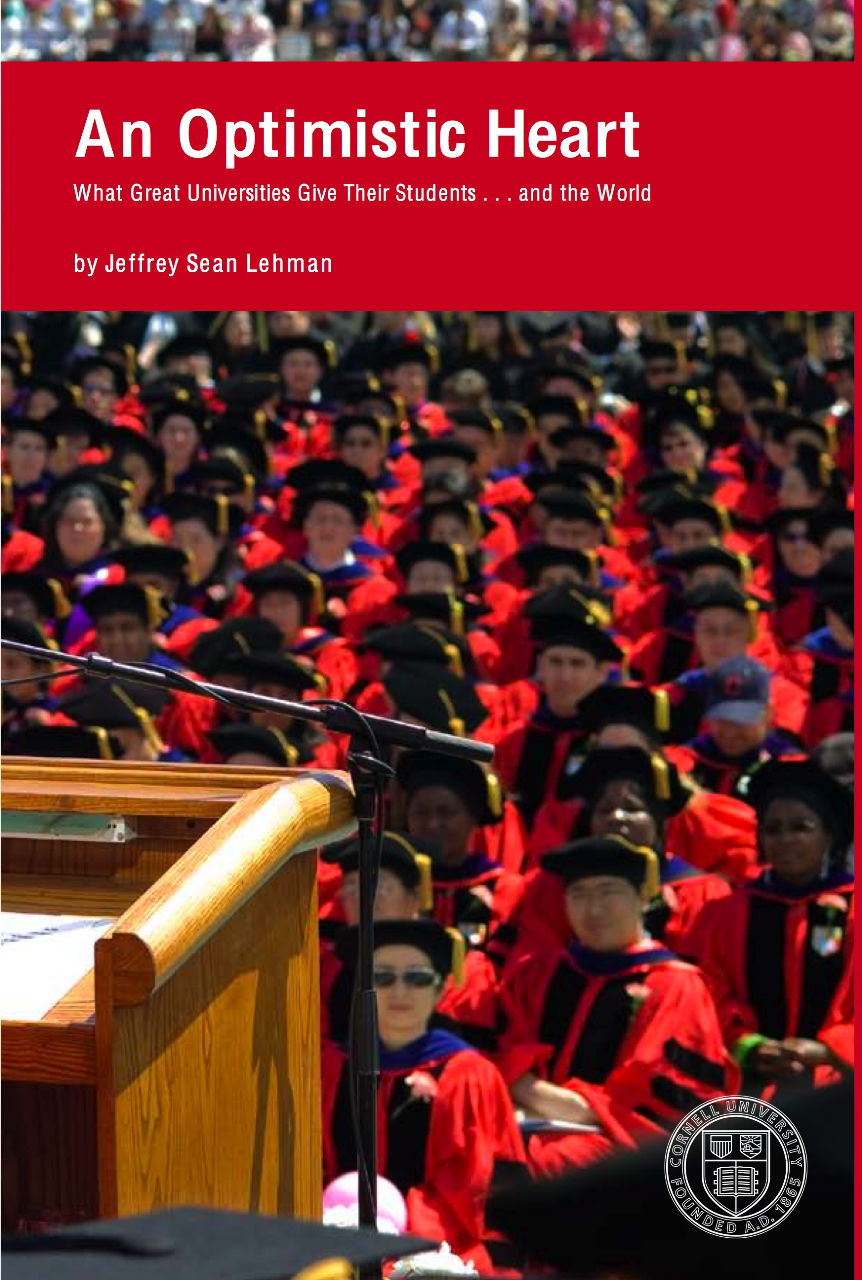


2004 Graduation Ceremony
The Cornell Law School
May 16, 2004
Members of the Law School Class of 2004.
On behalf of your university, I bring you warm congratulations on your achievements.
As a class, you will be leaving Ithaca to take up careers in locations all around the country, and as far away as France, Germany, India, China, and Japan. And you will be using your legal training in a wide variety of professional contexts, contexts that are likely to change many times over the course of your lifetimes.
But wherever you are, and whatever you are doing, you will draw on a broad array of talents that were nurtured during your time at the Cornell Law School.
I would like to take a brief moment to suggest how two of those talents – your capacity for critical analysis and your ability to be patient – can make a difference in your future careers.
During your time in law school, you have honed your capacity for critical analysis, your skepticism, to a razor sharp edge. You have become adept at fashioning a powerful counterargument to any argument.
I am sure your friends have noticed this enhanced ability. I am also sure that some of them have found it a bit tiresome. Because I know you have been practicing on them.
I picture you sitting at breakfast. Your friend says, “I like pancakes.” You immediately respond, “Oh, do you?” “Do you really like all pancakes?” Isn’t there at least one kind of pancake you do not like?” “Just what exactly do you mean by the word ‘pancake,’ anyway?”
This is a powerful skill. In its place. And as your university’s president I want to ask that you use it for good, and not for evil. In particular, please do not allow your heightened critical capacity to degenerate into relativism.
In law school, you have come to know that, upon reflection, issues are more complicated than they appear from a distance. You have come to see that good and admirable people may hold different and inconsistent perspectives on a complex problem. But you must not be content with that insight.
You must take it and use it to make choices, to develop nuanced ideals and reflective commitments of your own. You must use it to decide what you truly believe, and why you believe it. You have the capacity to be a sophisticated spokesperson for the ideals of others; you must remember to use that capacity to be a sophisticated spokesperson for your own ideals as well.
The practice of law is an ethically challenging career. Lawyers are always responsible for their actions; they are never just following orders. Every day, you will have to reconcile your duties to promote your client’s interests with other duties – to yourselves, to your communities, to the legal profession, and to the larger society. I hope that you will feel that struggle every day. If ever you do not, you should worry about what you have become.
And what about your patience?
In 1982, I had the privilege of working at the Supreme Court of the United States. One day at work, I received some important advice from the man who had argued Brown v. Board of Education, the case whose 50th anniversary we mark tomorrow.
I was meeting with one of Justice Thurgood Marshall’s clerks when the Justice himself happened to walk in to talk with that clerk about a case. I offered to leave, but the Justice insisted that I stay, and after the case discussion was completed we all talked more generally about the practice of law.
And during that discussion, Justice Marshall offered the following observation: “There’s only one kind of reputation that a young lawyer can get in a hurry, and it’s not the kind of reputation you want.”
What did Justice Marshall mean by that comment?
I believe he was telling us that the world of the lawyer is different from the world of the law student. There will be no more tests, no more grades. In the world beyond law school, many different human qualities contribute to success. And in that world, we are well served if we can be patient.
The ideal of patience has at least three different aspects.
In one form, the capacity for patience is cultivated in solitude. It connotes grace and equanimity, a certain spiritual transcendance. The patient one seems able to tune out the mundane pressures that bombard us, to listen to an inner voice, to wait.
A second form of patience, equally solitary and inner-directed, involves the ability to persist and endure in the face of rejection and defeat. The patient one fights and loses, but commits to soldiering on, to hasten the day when the tide will turn.
A third form of patience, however, is neither solitary nor inner-directed. It embodies an acute sensitivity to the needs and wishes of another person. Someone with this kind of patience can sublimate his or her own timetable, and refrain from acting until that other person is ready.
There is an important paradox here. To be patient may entail a certain heedlessness of others’ views and wishes. Or it may entail supreme sensitivity and accommodation to their distinct needs.
This paradox is like one that we often note in the domain of professional responsibility. At times we think the ethical lawyer is the one who stands up to a client or a senior partner in defense of what feels right. At other times we think the ethical lawyer is the one who can sublimate his or her personal judgment in deference to the considered judgment of a client or senior partner.
Critical analysis and patience. Both qualities call upon us to struggle. Both ask us to balance sensitivity to others with the preservation of an authentic and enduring sense of self.
Our world needs you to thrive in that struggle. As graduates of the Cornell Law School, I have every confidence that you will.
Know that today you are going forward with the support and affection of a worldwide family of fellow Cornellians. Congratulations, and good luck in all that you do.
